Instead of:
New price:
439,95€
Thinking of buying new skis but not completely sure which ones are right for you? Read the tips below and we’re confident you’ll quickly find the right match.
Read more







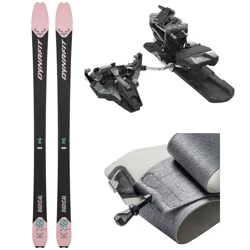


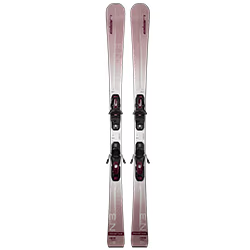

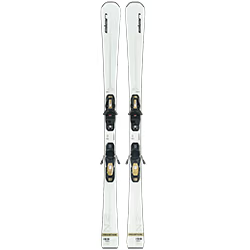







When choosing the right skis, you should first ask yourself what kind of terrain you will ski on most often. Do you enjoy carving turns on groomed slopes, long turns in fresh powder, jumps and tricks in the park, or do you prefer climbing the mountain with skis on your feet and skiing down your own line?
To make your ski selection easier, we have divided skis into several categories based on their intended use:
On-piste all-round skis: these are the most popular choice among skiers. Their key advantage is safe, comfortable and enjoyable skiing on groomed slopes throughout the entire day.
This category includes skis suitable for complete beginners as well as advanced and expert skiers. Beginners are advised to choose slightly shorter skis (approx. 10–15 cm below body height), narrower and softer models, as they are easier to control and more forgiving of technical mistakes.
More experienced skiers usually opt for longer skis (5–10 cm below body height), stiffer constructions and slightly wider platforms. These skis provide excellent control at higher speeds but require more strength, precision and an active skiing style.
In recent years, a trend towards slightly wider all-round skis has emerged from freeski-oriented countries such as the USA and Canada, as well as from France in Europe. Manufacturers have adapted these models for the Central European market (typically 78–86 mm underfoot), while retaining the key benefits of classic alpine skis – strong edge grip, torsional stability and lively performance. The added width improves performance in less-than-perfect conditions such as fresh snow, softer surfaces and spring skiing, offering more forgiveness and reaction time, while still delivering excellent grip on hard morning snow or freshly groomed pistes.
Women’s on-piste all-round skis: are designed for skiers who want to enjoy a full, confident and stable day on the slopes. These skis are adapted in both length and flex to suit the female physique.
Within this category you’ll find models for all skill levels, offering different responsiveness and turn radii. Skis intended for beginners and intermediate skiers are easy to handle, less aggressive, forgiving of technical errors and do not require excessive physical effort.
More advanced models reward skilled skiers with precise edge response and predictable turn transitions, but demand more energy and refined technique. Different turn radii allow each skier to choose a model that best matches her skiing style and preferences.
Ski length is selected according to skill level and desired character: for shorter turns and lower speeds, skis 10–15 cm below body height are recommended, while for higher speeds and a more dynamic style, ski length approaches the skier’s height.
On-piste all-mountain skis: are defined by their noticeably wider waist — 77 mm and above. They combine all the advantages of all-round skis: predictable edge grip, torsional stability and responsiveness.
The increased width underfoot and a more pronounced tip rocker improve flotation, especially in variable resort conditions such as fresh snow, softer surfaces, warmer winter days or spring skiing, while also allowing occasional enjoyable turns beside the groomed runs.
These skis are suitable for a wide range of skiers. The wider platform results in slightly slower and less aggressive edge-to-edge transitions, but provides greater stability and confidence at higher speeds. Their typically longer turn radii support smooth medium and long turns on all types of snow, helping less experienced skiers progress while offering experienced skiers stability and predictability. For increased stability and flotation, slightly longer ski lengths are usually recommended.
Women’s on-piste all-mountain skis: share a common feature — a wider waist width of 77 mm or more. They combine all the benefits of women’s all-round skis: reliable edge grip, torsional stability and responsive handling, while being specifically adapted to the female body structure.
The added width and pronounced rocker improve flotation in fresh snow, softer or spring conditions and allow for occasional off-piste turns near the slopes.
Designed for a broad range of skiers, these skis offer slightly calmer edge transitions combined with excellent stability and predictability at higher speeds. Their longer turn radii enable smooth medium and long turns regardless of snow conditions or skill level. Intermediate skiers benefit from easier progression, while advanced skiers appreciate stability and confidence at speed.
When choosing all-mountain skis, slightly longer lengths are preferred for better stability and flotation. Design also plays an important role — modern women’s models combine performance with premium aesthetics that make them especially attractive.
Racing skis: feature World Cup–inspired technology adapted for recreational skiers who want powerful, precise turns on groomed slopes. Racing skis are clearly optimized for slalom or giant slalom turns, with corresponding sidecut radii.
They incorporate advanced, race-proven materials and are chosen by expert skiers who demand aggressive, high-speed performance and possess excellent technique and physical conditioning. These skis offer maximum torsional stiffness, delivering exceptional stability, precision and bite throughout the turn.
In the slalom segment, the standard choice is a 165 cm ski with a radius of 11–12 m, while giant slalom versions are typically selected at body height or longer, with a radius of around 20 meters.
Freestyle skis: skis for all freestyle skiers. Jumps, rails, boxes, halfpipes, parks, or street spots are where freestyle skis feel at home.
Their main feature is that both tip and tail are equally upturned (allowing skiing backward), and bindings are mounted in the exact center of the ski. They are designed for tricks and acrobatic jumps.
Length choice depends on your skill: if you are inexperienced, we recommend skis about 10 cm shorter than your height. If you are already an experienced freestyler, choose skis as long as your height, as they will be more stable and allow safer landings.
Freeride skis: skis designed for skiing off-piste. Perfect on wide powder fields, cliff drops, steep couloirs...
Touring skis: if you love hiking up snowy mountains, you need touring skis. Their main features are lower weight, good float, and solid performance on all types of snow.
Touring skis have also become somewhat wider recently (90–100 mm underfoot) and use various rockers for better float. Wider, longer, and stiffer skis are suitable for experienced ski tourers.
For beginners, we recommend slightly narrower and shorter skis, usually about 10 cm below height. Touring skis must be combined with proper touring bindings and climbing skins for uphill travel.
Kids’ skis: designed for young skiers, from beginners to those already racing down snowy slopes.